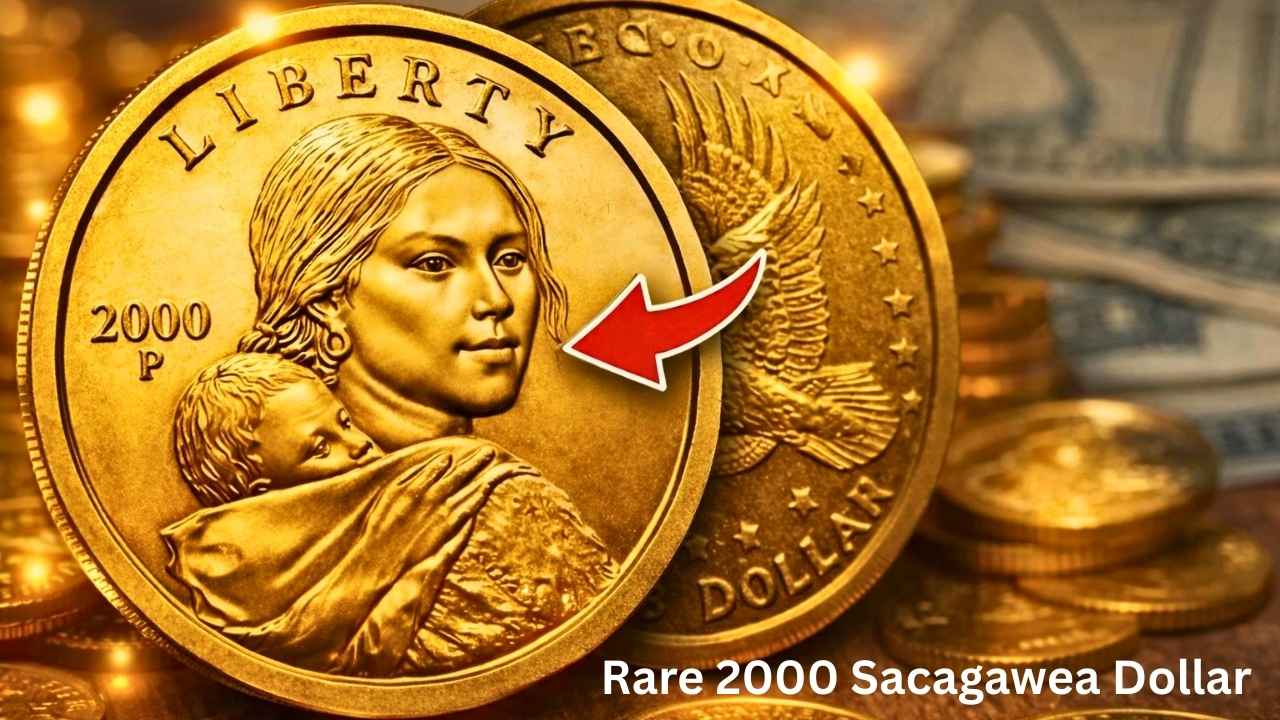
Coin collecting has always been filled with fascinating discoveries, but few modern coins have captured as much attention as the 2000 Sacagawea dollar. Released by the United States Mint at the beginning of the new millennium, this golden-colored coin was designed to honor Sacagawea, the Native American woman who helped guide the Lewis and Clark expedition.
While millions of these coins were produced, a small number of rare error varieties have turned ordinary dollar coins into valuable collector’s items. In some cases, these errors have sold for thousands of dollars, making them a surprising treasure hiding in plain sight.
Many collectors and everyday people are now checking their change more carefully, hoping to find one of these rare pieces. Understanding what makes these coins special can help you identify whether you might have one worth far more than its face value.
The Story Behind the 2000 Sacagawea Dollar
The Sacagawea dollar was introduced in 2000 as a replacement for the Susan B. Anthony dollar. The coin features a portrait of Sacagawea carrying her infant son, Jean Baptiste, on the obverse. The reverse design shows a soaring eagle surrounded by seventeen stars, representing the states that were part of the United States during the Lewis and Clark expedition.
The coin was made from a special manganese-brass alloy, giving it a distinctive golden appearance. The United States Mint produced millions of these coins in Philadelphia and Denver, but despite the large production numbers, several minting mistakes occurred during the early stages of production. These errors are now some of the most sought-after modern coins among collectors.
Why Error Coins Can Be So Valuable
Mint errors occur when something goes wrong during the coin production process. These mistakes can happen for many reasons, including incorrect dies, misalignment, or problems with the metal planchets used to strike the coin.
Because the minting process is designed to be precise and consistent, most errors are caught quickly. However, when a mistake slips through and enters circulation, it becomes a rarity. Collectors are especially interested in these coins because they represent unusual moments in the minting process.
The rarity of an error coin, combined with collector demand, can drive its value far above its original denomination. In the case of the 2000 Sacagawea dollar, a few specific errors have become particularly famous.
The Rare “Cheerios” Sacagawea Dollar
One of the most famous Sacagawea dollar errors is commonly known as the Cheerios dollar. In early 2000, the U.S. Mint partnered with the cereal brand Cheerios to promote the new coin. As part of the promotion, around 5,500 Sacagawea dollars were placed inside special cereal boxes.
At first, these coins seemed identical to the regular version. However, collectors later discovered that the eagle on the reverse had enhanced tail feathers, showing more detailed lines than the standard design used for most coins. This subtle difference created a rare variety that quickly became highly desirable.
Today, a genuine Cheerios Sacagawea dollar in excellent condition can sell for thousands of dollars at auction, depending on its grade and preservation.
The Mule Error Coin
Another legendary mistake involving the Sacagawea dollar is the mule error. A mule coin occurs when two dies that were never intended to be used together are accidentally paired during production.
In this case, a Sacagawea dollar reverse was mistakenly combined with the obverse of a Washington quarter. The result was a coin featuring George Washington on one side and the Sacagawea eagle design on the other.
Only a small number of these mule coins have been discovered, making them incredibly rare. Some of these pieces have sold for tens of thousands of dollars, and they remain among the most valuable modern U.S. mint errors.
Wounded Eagle Error
Another variety collectors look for is the Wounded Eagle error. On these coins, a raised line appears across the eagle on the reverse side, making it look like the bird has been struck by a spear or arrow.
This line is believed to be caused by a die gouge during the minting process. While it is not as rare as the mule error, the Wounded Eagle variety is still highly collectible. Depending on the coin’s condition, it can sell for hundreds or even thousands of dollars.
Collectors often inspect the reverse of their Sacagawea dollars carefully to see if this distinctive mark is present.
Other Possible Errors and Varieties
Besides the famous varieties, there are other minor errors that collectors sometimes find on 2000 Sacagawea dollars. These include off-center strikes, double strikes, and planchet errors.
While these mistakes may not always reach the high values of the Cheerios or mule coins, they can still be worth significantly more than face value. Some collectors enjoy searching through rolls of dollar coins specifically to find unusual minting flaws.
Even small differences in the coin’s appearance can sometimes lead to interesting discoveries.
How to Check If Your Coin Is Valuable
If you think you might have a rare Sacagawea dollar, the first step is to examine the coin carefully under good lighting. Pay close attention to the eagle’s tail feathers, unusual lines across the design, or anything that looks different from standard coins.
Using a magnifying glass or coin loupe can make it easier to spot small details. Comparing your coin with images of known error varieties can also help determine whether it might be special.
If the coin appears unusual, it may be worth having it evaluated by a professional coin grading service. Experts can confirm whether the coin is a genuine error and assign it a grade that reflects its condition.
Why Collectors Still Search for These Coins
Even though the Sacagawea dollar has been around for more than two decades, collectors continue searching for rare varieties. Many coins are still circulating, and new discoveries occasionally appear when people examine old collections or bank rolls.
The excitement of possibly finding a valuable coin keeps the hobby alive for many enthusiasts. A simple one-dollar coin could turn out to be a rare error worth hundreds or even thousands of dollars.
For this reason, coin collectors often recommend never overlooking modern coins. Sometimes the most valuable treasures are hidden in everyday pocket change.
Final Thoughts
The 2000 Sacagawea dollar is a fascinating example of how minting mistakes can turn an ordinary coin into a valuable collectible. From the famous Cheerios dollar to the extremely rare mule error, these coins continue to capture the attention of collectors around the world.
While most Sacagawea dollars are worth only their face value, a small number of error coins have become true treasures. Taking a few minutes to check your coins carefully could lead to a surprising discovery.
For collectors and casual observers alike, the story of these rare coins serves as a reminder that sometimes valuable history can be found in the most unexpected places.